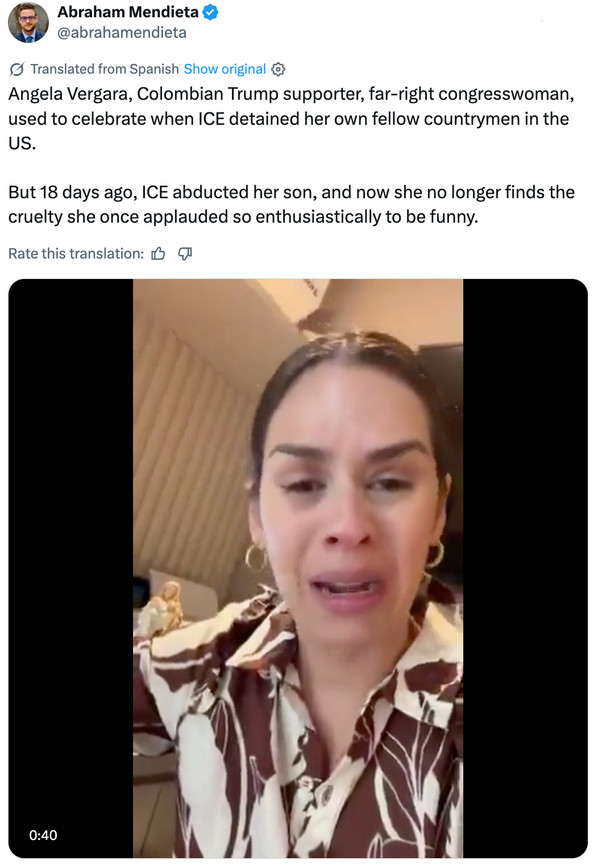
Angela Vergara's Unforeseen Reversal: When Immigration Policies Hit Home
In a striking turn of events that underscores the complex human dimension of immigration policies, Colombian Congresswoman Angela Vergara, a vocal advocate for stringent immigration enforcement, is now grappling with the harsh realities of those very policies. Known for her far-right political leanings and staunch support for former U.S. President Donald Trump’s immigration agenda, Vergara had previously praised the aggressive tactics of U.S. Immigration and Customs Enforcement (ICE). However, her public stance has seemingly undergone a profound shift following the detention of her own son, Rafael Alfonso Vergara, by ICE. This dramatic personal experience has thrust the conservative politician into an unexpected spotlight, revealing the intricate and often contradictory interplay between political ideology and personal anguish. The plight of
Angela Vergara's son has become a poignant symbol of how immigration policies, intended to regulate borders, can ripple through individual lives in deeply personal and unpredictable ways.
The Unforeseen Consequence: Rafael Alfonso Vergara's Detention and Conditions
The catalyst for Congresswoman Vergara's public reversal came with the detention of her 22-year-old son, Rafael Alfonso Vergara. According to his mother, Rafael was detained on a public road in Louisiana at 4 a.m. and subsequently held by ICE for over two weeks. Despite possessing a work permit and having a pending asylum application, conditions of his detention were reportedly dire. Angela Vergara described her son as "imprisoned and chained" for 18 days and suffering "inhumane conditions." She emphasized that her son was not undocumented, stating, "My son is not undocumented. My son is just another Latino who is suffering firsthand what thousands are suffering in the US. There are people like him who are not criminals." Furthermore, she highlighted his clean record, noting he had "never even committed a traffic violation."
This situation immediately drew significant attention due to the stark contrast with his mother's prior political positions. While
Angela Vergara's son had followed legal pathways by applying for asylum in 2023, a year after his 2022 arrival in the U.S., his detention reveals the complexities and potential vulnerabilities within the American immigration system. Even with valid permits and pending legal processes, individuals can find themselves ensnared in enforcement actions, often leading to prolonged detention. The reported conditions of his confinement also echo broader concerns raised by human rights organizations about the treatment of individuals in ICE facilities across the nation.
From Staunch Supporter to Urgent Petitioner: Vergara's Public Reversal
Congresswoman Angela Vergara has long been a prominent figure in Colombia's conservative landscape. As a member of the Conservative Party, she has openly expressed her support for the Republican Party in the United States and enthusiastically celebrated Donald Trump's potential return to the White House. Her political rhetoric consistently championed stricter immigration controls and she was known to publicly commend ICE's aggressive tactics against undocumented immigrants. However, the detention of her son has dramatically altered her public narrative, exposing a deep personal conflict between her ideological convictions and her maternal instincts.
In the wake of Rafael's arrest, Vergara immediately took to social media, posting a video where she tearfully recounted her son's ordeal and appealed for help. She described herself as "going through hell" and used her platforms to provide detailed accounts to various media outlets. In a remarkable shift from her previous stance, she publicly pleaded for intervention from Colombian President Gustavo Petro, seeking assistance in securing her son’s release. Her legal strategy also pivoted, opting to request voluntary return to Colombia for Rafael, believing it would be the quickest resolution. This move is a significant departure for a politician who previously upheld the uncompromising nature of immigration law. Her personal plea for intervention and her efforts to expedite her son's return underscore the profound human impact of policies she once championed, transforming her from a vocal supporter of aggressive enforcement into a direct petitioner against its consequences. To understand the full scope of this transformation, consider reading
From ICE Supporter to Victim: Angela Vergara's Son Detained.
Navigating the US Immigration System: Insights and Challenges
The case of
Angela Vergara's son highlights several critical aspects and inherent challenges within the U.S. immigration system, particularly for those in "pending status." Many assume that having a work permit and a pending asylum application provides immunity from detention, but this is not always the case. U.S. immigration law is intricate, and individuals with pending applications can still be subject to detention if deemed a flight risk, a danger to the community, or if their application process encounters unforeseen issues.
Understanding the role of ICE is crucial here. ICE's mandate is to enforce immigration laws, and its agents possess broad authority. While their primary focus is often on individuals deemed serious threats, arrests can occur for various reasons, including procedural flags, interpretations of status, or even during routine encounters, as Rafael's detention on a public road suggests. The reported "inhumane conditions" Rafael faced are also a point of ongoing concern. Numerous reports from human rights organizations and government watchdogs have documented issues within ICE detention facilities, ranging from inadequate medical care to prolonged solitary confinement.
For anyone navigating this complex system, legal representation is paramount. An experienced immigration attorney can guide individuals through the labyrinthine asylum process, advocate for their release from detention, and explain the nuanced differences between options like voluntary return and formal deportation, which carry significant implications for future entry into the U.S. As evidenced by Rafael's situation, even those with seemingly valid documentation can face detention, making informed legal counsel not just beneficial, but often essential. For more details on the specifics of his detention despite his permit, refer to
Angela Vergara's Son Rafael: Detained by ICE Despite Permit.
The Broader Implications: A Reflection on Immigration Discourse
The detention of
Angela Vergara's son transcends a mere personal anecdote; it serves as a powerful and often uncomfortable mirror reflecting the broader global discourse on immigration. This incident brings to the fore the tension between abstract political ideologies and the tangible human consequences of policies. It raises profound questions about empathy, hypocrisy, and the universal experience of parenthood.
For years, Congresswoman Vergara championed a policy framework that prioritized strict enforcement, often with little public discussion of the human toll. Her sudden reversal, marked by public pleas and a visible shift in strategy, highlights how personal experience can dramatically reframe one's perspective. It forces a contemplation of whether such shifts represent genuine ideological evolution, or simply a natural human response when the abstract 'other' becomes one's own flesh and blood. Her statement that her son is "just another Latino who is suffering firsthand what thousands are suffering" suggests a newfound, albeit painful, solidarity with a community she was once seen to be against. This case profoundly illustrates that while laws are designed to be impartial, their application is anything but. The story of Angela Vergara and her son is a stark reminder that behind every policy decision, every border patrol action, and every legal proceeding, there are individuals and families grappling with lives forever altered. It challenges observers to consider the full spectrum of impacts when crafting and enforcing policies that touch upon the fundamental human desire for safety, opportunity, and belonging.
Conclusion
The saga of Colombian Congresswoman Angela Vergara and her son, Rafael Alfonso Vergara, serves as a compelling and emotionally charged case study in the unpredictable journey of immigration politics. Her dramatic pivot from staunch advocate of rigid immigration enforcement to an urgent petitioner against its immediate effects on her own family underscores the deep human complexities often overlooked in political rhetoric. The detention of
Angela Vergara's son, despite his pending asylum application and work permit, peeled back the layers of policy debate to reveal the raw, personal anguish that immigration enforcement can inflict. This incident not only highlights the intricate and often unforgiving nature of the U.S. immigration system but also forces a broader societal reflection on empathy, the potential for political hypocrisy, and the universal bond between a parent and child. As the world continues to grapple with migration, this story stands as a poignant reminder that policies, regardless of their intent, inevitably have deeply personal consequences that can reshape perspectives and challenge even the most entrenched ideological stances.